July 22, 2024 · Magati Joel
Building a Full-Stack E-Commerce Platform with Next.js
A practical look at creating a modern online store with product management, authentication, payments, and an administrative dashboard.
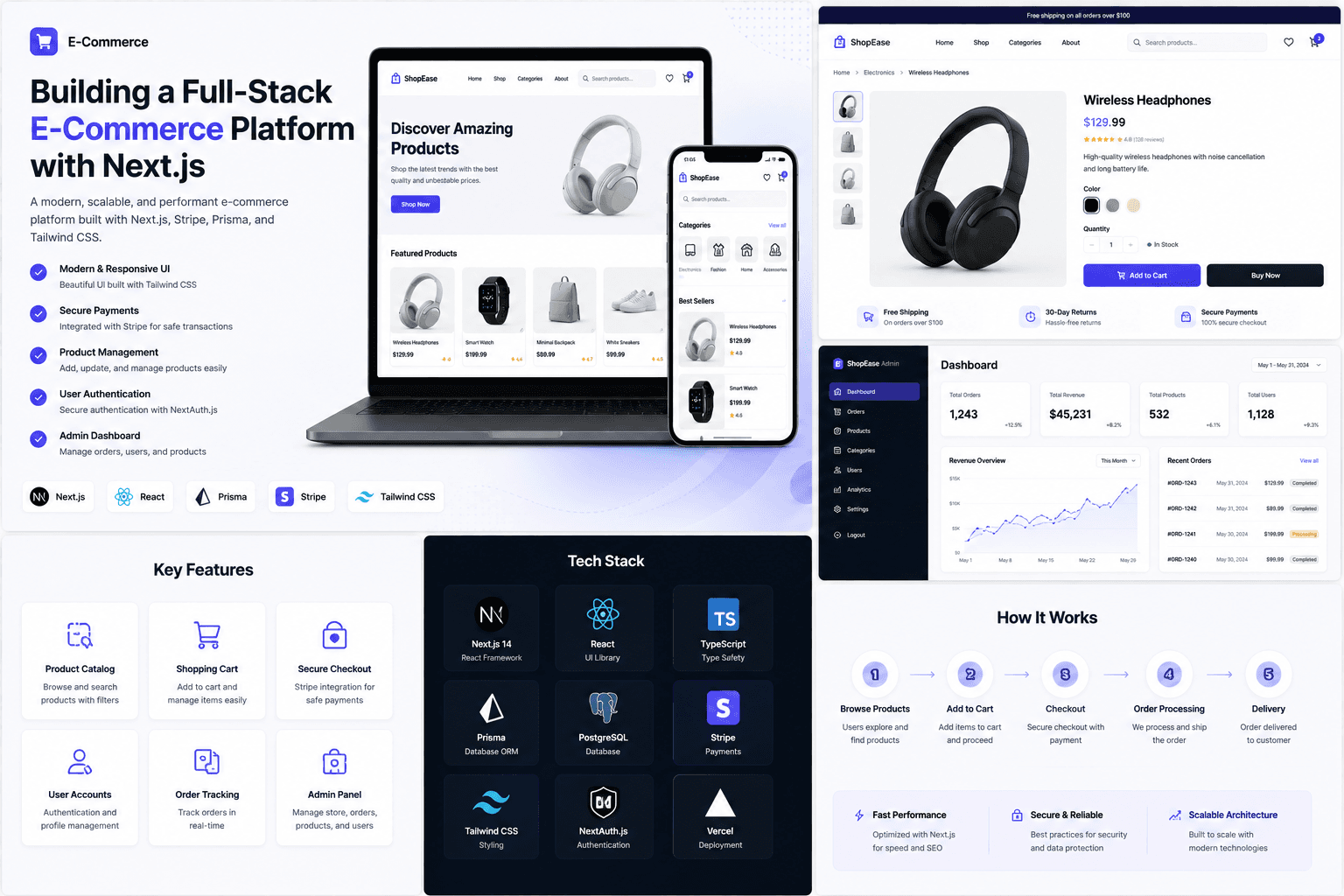
Why This Project Exists
An online store looks simple from the outside.
A customer browses a product, clicks “Add to Cart,” enters payment information, and receives an order confirmation.
Behind that short journey is a long chain of systems that all need to work correctly.
I built this e-commerce platform to understand those moving parts and bring them together in one modern Next.js application.
The Problem
A complete e-commerce platform needs much more than a product grid.
It must handle:
- Product information
- Categories
- Search and filtering
- Shopping carts
- User accounts
- Inventory
- Checkout
- Payments
- Orders
- Administrative management
- Responsive design
- Security
The customer experience must remain fast and simple while the backend protects data and keeps orders accurate.
Even small inconsistencies can create serious problems. A price shown on the product page must match the amount charged at checkout. Stock levels must remain accurate. Order creation should not depend entirely on the browser.
My Approach
I used Next.js to build both the storefront and server-side functionality.
The product catalog allows users to browse, search, filter, and open detailed product pages. Cart state tracks selected items, quantities, and totals.
Authentication provides users with access to profiles and order history.
Stripe handles secure checkout and payment processing. Rather than trusting totals submitted by the browser, the server retrieves product prices and calculates the expected amount.
The administrative dashboard provides tools for managing:
- Products
- Categories
- Orders
- Customers
- Inventory
- Store analytics
Prisma connects the application to PostgreSQL through strongly typed data models.
Interesting Challenges
Cart state became more complicated than simply storing an array of products.
The application needed to handle duplicate items, quantity limits, price changes, removed products, empty carts, and persistence across page reloads.
Payments introduced another level of responsibility.
A successful redirect from Stripe does not always prove that an order should be considered paid. Webhooks are needed to verify payment events independently and update the database reliably.
Database relationships also required careful planning. Products, categories, images, users, orders, order items, and payments all depend on one another.
Another challenge was preventing the admin dashboard and customer storefront from becoming tightly coupled.
The Tech Stack
The platform uses:
- Next.js
- React
- TypeScript
- Tailwind CSS
- ShadCN UI
- Prisma
- PostgreSQL
- Stripe
- Authentication
- Zod
- Vercel
Next.js allowed the storefront and backend logic to remain within one project while still keeping responsibilities separated.
Lessons Learned
E-commerce applications require the server to remain the source of truth.
Prices, inventory, payment status, and order totals should never rely entirely on client-side values.
I also learned that checkout should contain as little friction as possible. Every additional field or unclear message increases the chance that a customer abandons the purchase.
Good database modeling made later features easier to implement. Decisions about order items, product snapshots, and payment status affected the entire system.
Final Thoughts
Building this platform gave me a much deeper understanding of what happens behind a modern online store.
The visible interface is only one part of the product. Reliable payments, accurate data, secure server logic, and useful administrative tools are equally important.
Future improvements include wishlists, reviews, discount codes, shipping integrations, abandoned-cart recovery, email notifications, and advanced analytics.
The project showed me that the best e-commerce experience is built when complex systems work quietly behind a simple interface.